
The Capacity Constraint
AI can improve faster than its supply chain can expand.
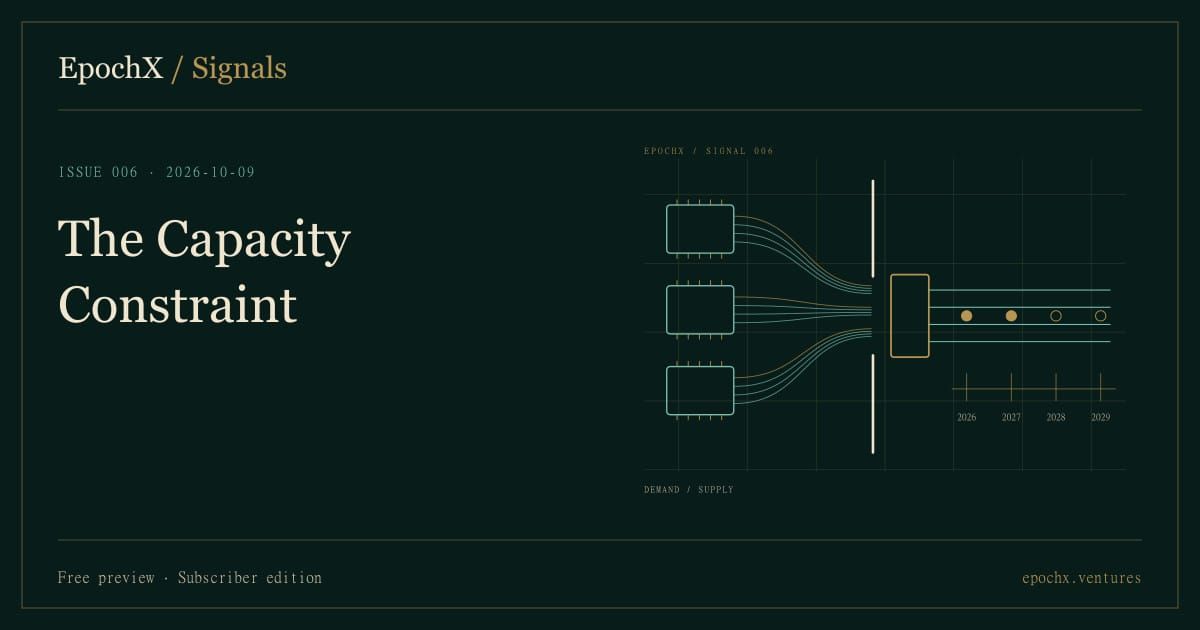
Lumentum’s optical components are “completely sold out” through early 2029, chief executive Michael Hurlston told Bloomberg on 9 October. For some products, the company cannot meet about 70% of demand through next year. Six months ago, its reported sell-out horizon was 2028. The queue has lengthened even as the company works to increase production. Bloomberg
That gives the AI expansion a physical timetable. Customers can order more computing power. Suppliers still need to build the parts.
The factory sets the pace
Memory faces a similar constraint. Micron expects memory and storage supply conditions to tighten further in 2027 and 2028. Its first New York factory is scheduled to begin wafer output in 2030. Even after a factory starts, production takes several quarters to reach meaningful volume. Micron’s prepared remarks
The financial scale is striking. Samsung’s preliminary third-quarter guidance put operating profit at 107.4 trillion won, against 12.17 trillion a year earlier. Those are company-wide estimates; the guidance does not isolate the contribution from memory. Samsung
Our view is that manufacturing capacity will help determine how quickly AI moves into wider use. Better models create demand for more equipment. That demand must pass through factories with limited output.
Shortages change the product
Tesla provides a direct example.
On 1 October, Elon Musk said Tesla had reduced the planned memory capacity for AI5 and AI6 to secure enough supply for Optimus production and reduce costs. He said memory bandwidth would remain unchanged. Tesla subsequently revised AI5’s planned capacity from 72GB to 96GB, still below the earlier 144GB configuration. TeslaNorth · Musk’s follow-up, reported by Drive Tesla
Capacity determines how much data memory can hold. Bandwidth determines how quickly that data can move. Tesla’s stated approach preserves the second while reducing the first.
This illustrates how buyers respond when a component is scarce. They can reserve supply, pay more, change suppliers or redesign the product. Each choice affects cost, performance and the number of units they can build.
Supply now shapes both the production schedule and the product design.