
A Hall Counted in Fibers
The network determines how much of an AI cluster becomes useful compute.

Explaining why his GPU deployments came in unusual multiples of 110,000, Elon Musk pointed to a physical constraint:
A GPU installation is a large capital commitment. Its economics depend on how much useful work those processors can perform together. When communication becomes the bottleneck, part of that investment waits for data.
That is the investment significance of the network. Better connections can improve the productivity of the entire installation.
Musk’s figure describes a particular deployment, rather than an industry-wide ceiling. The broader question is how to connect more processors, move more data between them, and contain the power and complexity required to do both.
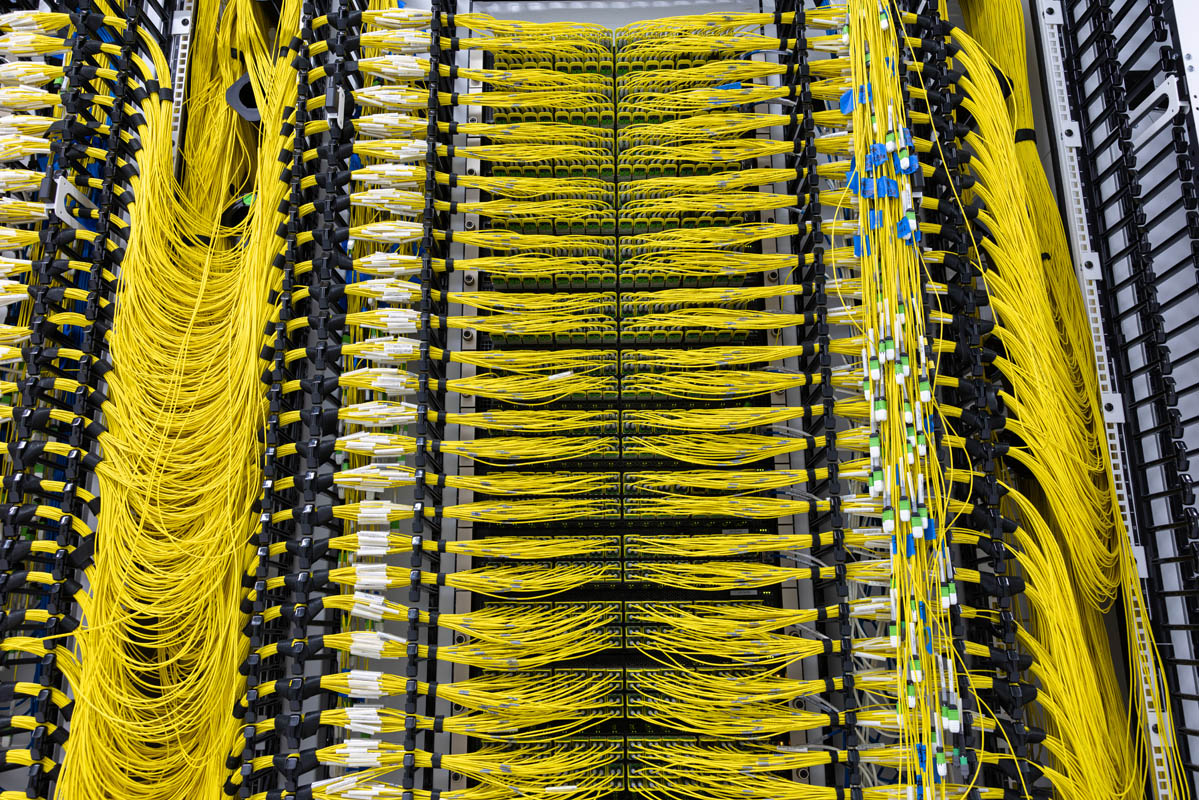
This archive image does not depict the September 2026 configuration.
When computation has to travel
An AI cluster distributes work across many processors. The network carries the information those processors need to coordinate and complete their tasks.
The model’s architecture shapes that traffic. In mixture-of-experts models, specialized parts of the model can reside on different GPUs. Processing a token can require sending work to selected experts and gathering their results. Uneven workloads and slow exchanges can leave some processors waiting while others remain busy.
NVIDIA’s work on expert-parallel communication illustrates how consequential this becomes: improving the movement of data can raise model-training throughput without adding GPUs. Software, scheduling and network hardware all contribute to the result. NVIDIA technical analysis.
Counting GPUs tells us how much equipment has been installed. Understanding the connections helps explain how effectively that equipment can operate.
The capacity between the chips
Broadcom’s Tomahawk 6 provides a useful example. The switch chip delivers 102.4 terabits per second of aggregate switching capacity. Broadcom describes two-tier networks connecting more than 100,000 accelerators at 200 gigabits per second per link.
The link speed matters. A fixed amount of switching capacity can support different combinations of connection count and bandwidth per connection. A large accelerator count, on its own, says little about the bandwidth available to each machine. Broadcom announcement.
Additional switching tiers and parallel network paths can support larger installations. They also bring more equipment to power, connect, manage and maintain. Expansion is a system-design problem.
Fiber already carries traffic across AI data centers. The next development is to increase optical capacity and bring the conversion between electrical and optical signals closer to the silicon.
Co-packaged optics places optical engines alongside the switching chip, shortening the electrical path that high-speed signals must traverse. NVIDIA’s SN6800 illustrates the scale of this approach: a four-chip switching system with 409.6 terabits per second of aggregate capacity. That is a system-level figure, rather than the capacity of a single chip. NVIDIA hardware documentation.
These architectures will coexist. Copper remains useful for short connections. Pluggable optics, co-packaged optics and emerging optical I/O serve different requirements. Adoption will depend on bandwidth, distance, power consumption, serviceability and cost.
The investment question begins where the engineering choices become purchasing decisions.