
The Political Interconnect
The midterms changed the terms of America’s AI buildout. The investment question is which companies can turn planned capacity into working infrastructure.
The view
The next AI campus needs a community willing to host it, a utility able to serve it, and an agreement about who pays. This week’s election made those requirements harder to overlook.
Democrats won control of both chambers of Congress. Their new majorities take office in January; Donald Trump remains president. That creates divided government, with different institutions able to influence different parts of the AI economy. AP’s election calls.
My base case is a more selective buildout: greater delay risk for new projects, more scrutiny of developers, and continued differences between state rules. A comprehensive federal AI law is a harder proposition.
For investors, the distinction that matters is between capacity someone intends to build and capacity that can actually serve a customer.
What a century of returns says
Before turning an election result into a market forecast, it helps to examine the record. I calculated returns from July 1926 through September 2026 using Kenneth French’s value-weighted Business Equipment portfolio: a historical proxy covering computers, software and electronic equipment. Its composition changes over time. It is neither the Nasdaq nor a century-long record of today’s AI companies. Data and portfolio construction.
Across that sample, the proxy compounded at an annualized 17.2% during Democratic presidencies and 5.9% during Republican presidencies, including dividends. The broad U.S. equity market returned 13.9% and 6.5%, respectively. These are EpochX calculations from the daily research series, grouped by time in office—not averages of individual presidents’ returns.
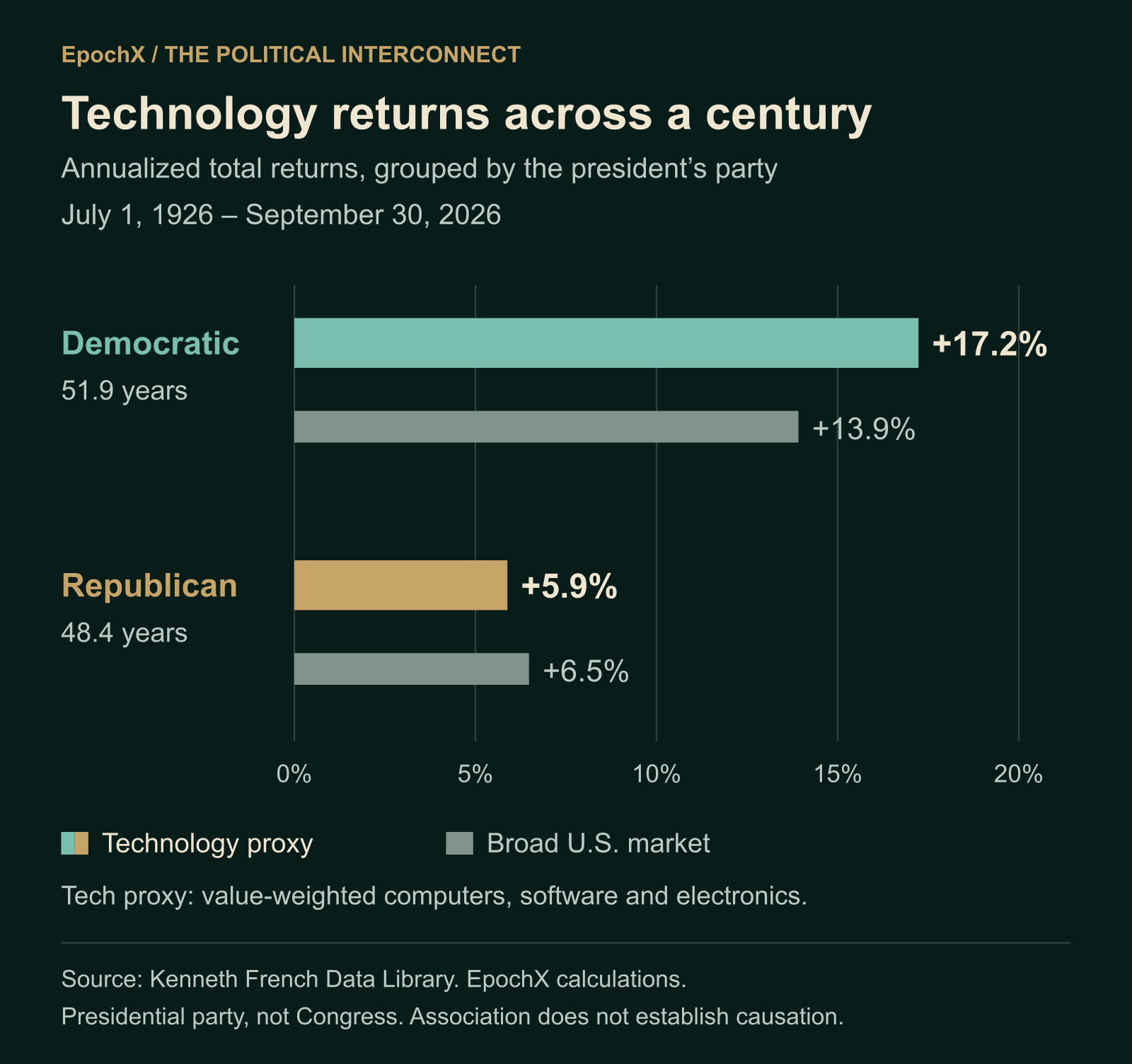
The comparison changes with the period. Since January 2009, the same technology proxy returned 18.0% during Democratic presidencies and 28.2% during Republican presidencies. Both results belong in the analysis. Neither establishes what a party caused or what comes next.
This week changed control of Congress, not the presidency. A chart grouped by presidential party cannot tell us the effect of a Democratic Congress under a Republican president. For this buildout, the useful questions remain specific: which rules change, which projects they cover, and who pays.
Where the calendar changes
Texas makes the shift concrete. Governor-elect Gina Hinojosa wants approvals paused until lawmakers establish protections covering household costs, water, labor and transparency. But the starting point matters: Governor Greg Abbott had already restricted grid connections and environmental permitting while the state audited projects. The dispute crosses party lines. The Texas Tribune.
Ohio’s Amy Acton has proposed a conditional moratorium, including requirements that developers cover utility costs and meet labor, environmental and community standards. In Georgia, Keisha Lance Bottoms has promised an executive-order pause on new construction. Ohio’s Statehouse News Bureau, CBS News.
These incoming administrations’ promises are not yet their enacted policies. Coverage, exemptions, legal authority and implementation will determine the effect on individual projects.
Local votes reinforce the pressure. Ballotpedia reported outcomes favoring restrictions in 40 of 41 data-center ballot measures. Those were votes in particular communities, not a national referendum, but they matter directly to projects in those jurisdictions. Ballotpedia.
A national slowdown cannot be calculated from that tally. It does justify closer scrutiny of where projects sit, which approvals they still need, and whether their power commitments survive a change in policy.
Oversight can move before legislation
Congressional control brings hearings, investigations and the ability to compel testimony. Reuters reports plans for bills on independent model testing, developer liability and data-center electricity costs. Presidential opposition makes sweeping legislation difficult; narrower agreements and provisions negotiated into must-pass bills remain possible. Reuters.
Senator Maria Cantwell’s framework shows the direction of one proposal: enforceable federal standards, independent audits before covered models are released, and continuing testing and incident reporting. It is a framework, not enacted law. Senate Commerce Committee.
The near-term planning problem is overlapping obligations. Companies may face state requirements while federal proposals develop. Foley & Lardner’s post-election analysis considers congressional preemption of state AI laws less likely. Foley & Lardner.
The useful test for regulation is whether it creates measurable duties, credible enforcement and a predictable route to compliance. Conflicting rules and indefinite reviews can raise costs without making systems meaningfully safer. Clear standards can help customers and communities decide what they are prepared to trust.
Who pays for the buildout
OpenAI’s November 5 community compact offers one response. For future campuses it owns and operates, the company commits to paying the full cost of electricity and supporting infrastructure, providing financial assurances, reporting resource use, and limiting confidentiality agreements with public officials. These are company commitments with a defined scope, not industry-wide law. OpenAI’s compact and policy blueprint.
The principle is straightforward: a developer should be able to demonstrate that its project works economically after accounting for the costs it creates.
That could make some projects more expensive. It could also give viable projects a clearer route forward. The question is whether governments turn public concerns into conditions a developer can satisfy—or leave approvals indefinitely uncertain.